
What Nemaha County Deed Records Reveal
The Nemaha County Register of Deeds keeps the county's title records. It handles every deed submitted for recording. Staff examine each instrument, whether mailed or brought in. Then they stamp it with a recording time, assign it a book and page, and index it by party name and legal description. Recording a deed in Nemaha County does not judge whether the title is clear. It simply makes the document part of the public record.
| Deed Type | What It Does | Common Use |
|---|---|---|
| Warranty deed | Conveys the stated interest with warranties | Ordinary sale |
| Quitclaim deed | Conveys whatever interest the grantor holds | Family, entity, or corrective transfer |
| Correction deed | Corrects information in an earlier instrument | Name or description cleanup |
| Trustee / executor deed | Records a fiduciary conveyance | Trust or estate transfer |
| Sheriff / tax deed | Documents a transfer through a statutory process | Foreclosure or delinquent tax proceeding |
Deeds are only the start of what the office records. Mortgages, liens, oil-and-gas leases, and city-addition plats all sit in its holdings. Powers of attorney, corporation records, cemetery records, and former county-school records do too. Search releases, assignments, satisfactions, and corrections alongside the deeds themselves. The school and cemetery materials are unusual local resources for rural-property history. Neither can substitute for the conveyance chain.
How Nemaha Instruments Become Index Entries
Once an instrument is accepted, it receives a recording time and a book-and-page reference, and the indexer enters it by name and legal description. Record the document type, date and time, grantor, grantee, locator, and the full land description as you go. Street addresses change over time. Early deeds often omit them entirely, so the legal description is the reliable thread.
| Grantor | The party conveying an interest |
|---|---|
| Grantee | The party receiving an interest |
| Chain of title | The connected sequence of transfers |
| Book/page | The archival locator for the instrument |
Nemaha County publishes no verified public deed-index URL, online cutoff, or image cutoff. Contact the office directly rather than reading an absent web result as proof that no deed exists.
Walk Nemaha's Grantor-Grantee Chain
Start with the newest deed. Match it to the exact legal description. The current grantee received the stated interest, and the grantor is the previous link in the chain. Search that grantor as a grantee in the earlier period, then repeat the process, comparing the same parcel of land at every step.
- Save the newest deed's grantee, grantor, recording reference, and legal description.
- Search the grantor as a grantee in the earlier index period.
- Test entity abbreviations, trustee or executor wording, and spelling variants.
- Repeat backward; include probate, sheriff, tax, plat, and correction records.
- Grantor
- The party transferring the stated interest.
- Grantee
- The party receiving the stated interest.
- Chain of title
- The ordered, connected sequence of instruments for the same land.
- Book/Page vs Instrument #
- Alternative locators used to retrieve a recorded document.
Apply Kansas Deed Fees Carefully
Kansas sets deed fees by statute. K.S.A. 28-115 lists $17 for the first page and $13 for each additional page of covered deeds, mortgages, and other instruments filed from 2018, along with $32 per town-plat page, $16 for a mortgage release or assignment, and $13 for a certified instrument. K.S.A. 28-115a adds a $3-per-page technology fee to covered filings. Before calculating any total, verify the current county fee PDF. Most recorded instruments are open records. The Kansas Real Estate Sales Validation Questionnaire is the exception, restricted by the state. The county states it is available to taxpayers protesting taxes and to Kansas Certified General Real Property Appraisers. Even when that questionnaire stays closed, the deed it accompanies can remain fully open.
Nemaha Land Books Begin in 1855
Recorded land in Nemaha County goes back to before statehood. The Nemaha County Historical Society identifies land records beginning in 1855. Its holdings include 1887 plat maps. There is also a 1908 plat book, a 1922 atlas, surveys, and town-specific Sanborn maps. These materials can reconnect an old name, lot, or changed street with a modern parcel. Treat historical maps as finding aids, not proof of title. Confirm every transfer in the courthouse deed books or through the cataloged FamilySearch pathway. The precise web cutoff is unverified. So the oldest online result is not necessarily where ownership began.
Note: The 1855 record start predates modern parcel numbers, making exact legal descriptions and book/page references essential.
Connect Deeds with Mortgages and Releases
A deed is just one piece of the recorded trail. Nemaha County also records mortgages, assignments, and releases. It also files material and service liens, federal and state tax liens, oil-and-gas leases, and powers of attorney. Search the same party-name variants and the same legal description around each transfer date. A release or satisfaction shows whether a recorded claim was later cleared. An assignment shows a lender's interest moving without any change in ownership. Court judgments and lis pendens may live in a separate District Court search. The deed index points the way to documents. Interpreting their legal effect belongs with a qualified title professional.
Follow City-Addition Plats into the Deeds
The Register of Deeds lists plats of city additions among its recorded instruments. When a deed cites a subdivision, block, and lot, pull the referenced plat. Check it for later replats, vacations, corrections, or dedicated easements. These filings explain why an older description may not match the current parcel map. They also clarify an apparent lot line that conflicts with the map's shape. For rural land, keep the section, township, range, acreage, and survey references together. Keep every exception clause with them as well. A historic plat or atlas helps locate the tract. Only recorded instruments and applicable survey evidence connect the legal chain.
Request an Offline Nemaha Deed Index
The Kansas Open Records Act is a strong tool. It applies when an index, image, or historic book is not available remotely. Send a narrow request to the Register of Deeds. Name the party names, legal description, instrument type, and date span. K.S.A. 45-218 requires the agency to act by the third business day. When production takes longer, the response should give the reason and an anticipated date.
KORA delivers existing records, not a custom chain-of-title report. Reasonable actual costs may cover staff search, review, copying, electronic production, or delivery, and the office may request prepayment. Ask for an estimate first. Then decide whether an office visit, a plain copy, or a certified instrument fits the purpose best.
Test Every Break in a Nemaha Deed Chain
A tidy surname chain rarely survives every twist in Nemaha County deed records. Splits, combinations, and platted additions can break it. So can a vacated plat or a correction instrument that rewrites the legal description. Executors, administrators, trustees, sheriffs, and even the county appear as grantor too, names that never occupied the ordinary tax-roll owner spot. Search both the parties and the land description on each side of the gap. Match parcels, not just names.
Probate opens a second record trail. Start with the District Court case name and its event index. Then request the petition, order, inventory, or final settlement that matters. The executor, administrator, or heir deed will be waiting at the Register of Deeds. A death certificate by itself never transfers title. Remote access varies by case and document under Kansas eCourt Rule 22, while a courthouse public terminal may expose material unavailable from home.
Read mortgages and liens as claims or security interests, never as automatic transfers of ownership. Follow each mortgage through its assignments and releases. Tie any lis pendens, foreclosure judgment, or tax-sale process to the deed that gets recorded afterward. This wider deed-records search keeps a single index entry from being mistaken for the land's full history.
Prepare for Historic Research Before Visiting
Plan ahead before visiting the Historical Society. Staff ask researchers to build a catalog list and email it at least two weeks ahead. That way materials can be pulled in advance. Include the four-digit year and the two-part item number whenever available. Museums are open Tuesdays from 10:00 a.m. to 4:00 p.m. Other days run by appointment, and weather closures are possible.
The supporting collections run deep. They hold the WPA Pioneer Index, the 1855 and 1857 censuses, naturalization records from 1859 through 1870, cemetery notebooks, school directories, marriage-license applications, and obituary clippings. They also hold local newspapers. Such sources can separate same-name parties or point toward heirs. Even so, every ownership conclusion must return to the recorded Nemaha County deed. It must rest on its legal description.
Get a Nemaha County Deed Copy
The Register of Deeds sits at 607 Nemaha Street, PO Box 213, Seneca, KS 66538. Call 785-336-2170, option 4. You can also fax 785-336-3373 or email rod@nmcoks.us. Hours generally run 8:00 a.m. to 4:30 p.m., and the office stays open through noon. Confirm terminal access, current fees, image delivery, and payment methods before you travel. Do not mail any payment without checking first.
Give the office party names, an approximate recording date, and the instrument type. Add the book/page or instrument number when known, plus the exact legal description. Then state clearly whether you want an informational copy or a certified copy. A focused KORA request can reach an offline index or archived item. Actual-cost fees and prepayment may apply.
Recorded, not guaranteed. An indexed deed is a public instrument, not a title opinion; it does not resolve defects, boundaries, easements, or unrecorded interests.
Consult the official office page for current contact and fee links.
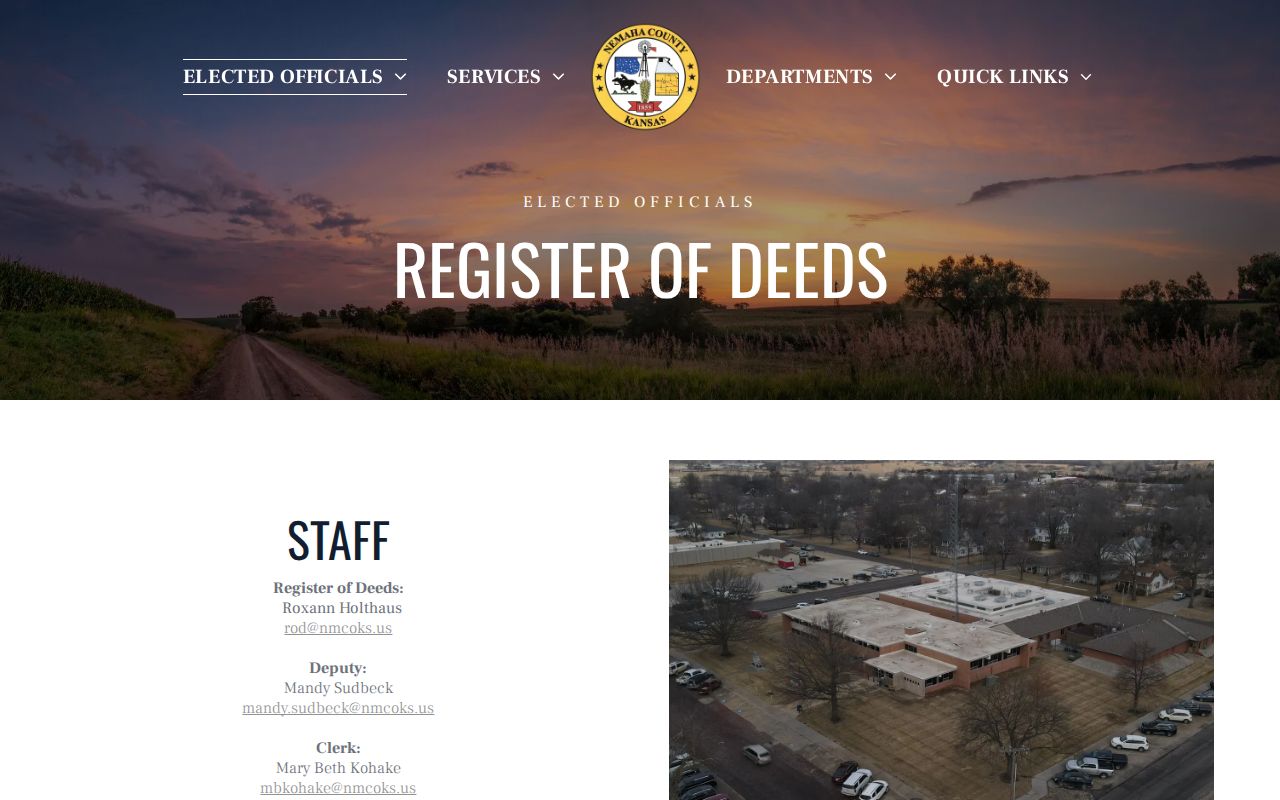
The county publishes no online deed-search portal. The Register of Deeds office page is therefore the authoritative access point. For a mailed request, describe the instrument narrowly and ask staff to confirm the expected charge before you send funds. A single document can span several pages. Check the county-linked fee schedule in its current form. Keep your copy with its book/page, recording date, and legal description so it can be matched to the next instrument in the chain.