
Compare Nemaha County Property Values
One Nemaha County parcel can carry several amounts. The appraised figure is the Appraiser's market-based estimate, and Kansas then applies a constitutional percentage by property class to reach assessed value. Exemptions or relief may change the taxable result. A sale or deed consideration is a transaction fact, if public and shown.
| Value | What It Is | Where |
|---|---|---|
| Appraised value | County's market-based mass-appraisal estimate | Appraiser parcel record |
| Assessed value | Appraised amount multiplied by the class percentage | Assessment and tax records |
| Taxable value | Result after applicable exemptions or adjustments | County tax roll |
| Sale or consideration | Amount or transfer language tied to one transaction | Deed if public and shown |
These numbers can differ without any error. They arise from different dates, rules and uses, and Kansas restricts sales-validation questionnaires, so no public Nemaha sale-price field exists.
Apply Kansas Ratios to Nemaha Values
Kansas Constitution Article 11 fixes assessment levels by class. Residential real property is assessed at 11.5 percent of appraised value. Vacant lots and qualified nonprofit property use 12 percent. Commercial and industrial real property and agricultural-use improvements use 25 percent. Agricultural land is valued by income or productivity. It is assessed at 30 percent. Other urban or rural real property also uses 30 percent. Public utilities use 33 percent. These ratios are not tax rates and not discounts from a likely sale price.
Locate a Nemaha Assessed Value
The county tax search accepts street address, name, legal-description and rural section-township-range routes. Match the CAMA identifier and legal description first.
- Enter Street Number and Street Name, or use the rural land fields.
- Confirm situs, CAMA number, class and legal description.
- Record appraised, assessed and taxable labels with the tax year.
- Check a deed only for transaction context, not as proof of today's market value.
- Appraised value
- The county's mass-appraisal estimate.
- Assessed value
- The class percentage applied to appraised value.
- Assessment ratio
- The constitutional percentage assigned to the class.
- Reassessment
- A later valuation cycle that can change the record.
Use Nemaha Appraiser Value Records
The Nemaha County Appraiser maintains ORION parcel records. Public and registered access differ. Sales information stays reserved to licensed appraisers under the county statement, so ask the office when a needed public field is absent.
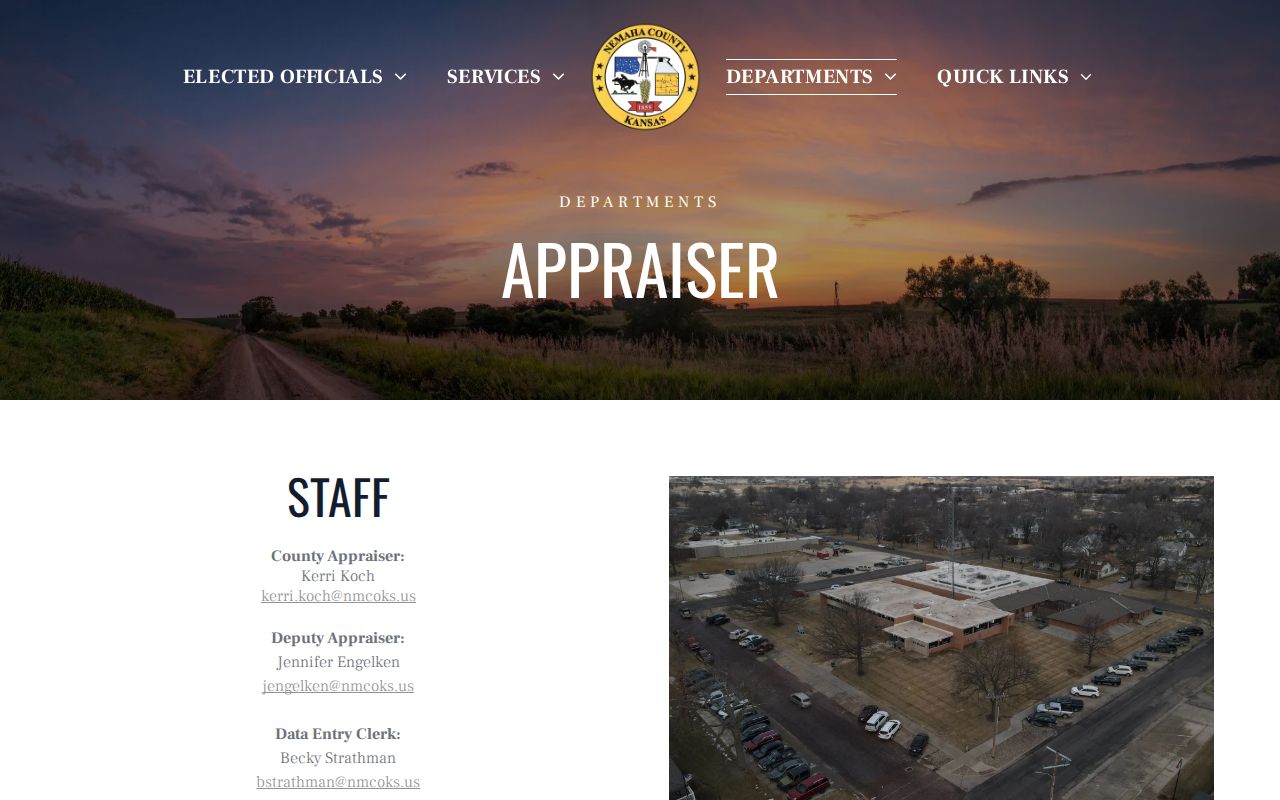
The page links valuation and relief material; keep the year.
Place Nemaha Values in Context
The state's 2024 summary reported $234,900,723 in total taxable value for Nemaha County and $25,567,620 in ad valorem tax. Residential property accounted for $80,779,037. Agricultural land came to $66,620,013. Public utility property represented $45,422,512. Those county totals show scale, not a parcel rate or value, and the summary's average mill levy of 0.108844 cannot replace the taxing-unit mix and special assessments attached to one parcel.
Read Nemaha's 2026 Market Signal
The 2026 county market study reports residential trends generally up 3 to 10 percent depending on location and home type. Commercial property was stable to slightly upward. Vacant lots were stable. Rural vacant land trended upward. The study is countywide under K.S.A. 79-1460a, not a comparable-sales report for one address, and a parcel can move differently because of class, condition, land use or neighborhood evidence.
Explain Nemaha Taxable Differences
Homestead relief, disaster relief and other exemptions may change the taxable outcome without touching the plain meaning of appraised value. Neighborhood Revitalization is a separate record stream. Its application must precede construction. A $35 fee applies. Nemaha County, Sabetha and Seneca plans carry different rebate terms, and that rebate context does not turn the assessed amount into a sale estimate. Note: Tax bills, due dates and appeals belong in the county's property-tax records, not in a market-value comparison.
Separate Nemaha Sales from Value
A deed may show consideration or transfer language. The Kansas Real Estate Sales Validation Questionnaire stays restricted. A family transfer, estate deed, partial interest or bundled acreage may not reflect an ordinary open-market deal. The public ORION view may lack sales. Ask the Appraiser what public record is available and use the recorded deed for its actual terms.
Date Every Nemaha Property Value
Real-property valuation notices are mailed by March 1 in the county's annual cycle. Labels matter. That date marks when an owner sees the new value. The number still belongs to its stated assessment year. Later market news or a new sale should not be blended into it silently. Save the value label, class, year, and parcel key for your own notes. If ORION and a notice differ, ask the Appraiser which record controls the current roll. The map's March and October update cycle is separate. Do not use it to date the value itself.
The distinction is simple. Appraised value describes the county estimate. Assessed value applies the Kansas class ratio. Taxable value reflects further adjustments. The eventual bill also depends on mill levies and special assessments. Those bill mechanics belong with the Treasurer and Clerk records.
Confirm the Nemaha Property Class
A ratio only works once the class is right. Not every class shares one percentage. Nemaha County treats residential real estate, agricultural land, commercial improvements, vacant lots and utilities differently, and agricultural land gets income and productivity valuation, so a house-price comparison tells you nothing there. Mixed use adds another wrinkle. So does new construction. Read the county classification rather than picking a ratio from appearance, since land and improvements may be listed separately. The Appraiser will explain any classification or value field that is unclear, and that explanation should stay separate from the Treasurer's later tax calculation.
Request a Nemaha Value Record
The public parcel view can fall short. Contact the Appraiser instead. The office sits on the bottom floor at 607 Nemaha Street in Seneca. Hours run 8:00 a.m. to 4:30 p.m., through noon. Ask for an existing parcel card. List the CAMA number, situs, legal description and year. A Kansas Open Records Act request is another route to a current or archived tax card. K.S.A. 45-218 gives the county until the third business day to act, though it may explain a delay and estimate actual-cost fees. The law does not require staff to create a private appraisal or a custom market report. History needs a different ask. Request the value record by year rather than treating today's ORION screen as the whole series. Keep classification, acreage, improvement and exemption changes beside the values so the trend keeps its context.
Limit a Nemaha Property Value
This number serves tax administration. A Nemaha County assessed value does not promise what a buyer will pay, cover the cost of repairs, prove a boundary or replace a title search. The effective year and property class give it context.
Value is not price. An assessed value is not a sale guarantee or private appraisal. Use a qualified appraiser for a date-specific opinion.
Levy, bill, exemption and protest mechanics live elsewhere. See the Nemaha County property tax records material for those details, and keep valuation meaning separate from the amount due. Comparisons need like years and like classes. A shift in land area, improvement entry, exemption or classification can move the assessed figure even when the broad market looks calm. Save the parcel card each time. Save the notice date and class too. If the 2026 county study comes up, treat it as a market-study trend rather than evidence of one parcel's sale price or a private appraisal.