
Read Nemaha County Property Tax Records
Nemaha County splits its property tax records across two offices. The Nemaha Tax Information Module holds tax statement and payment status details. The Appraiser keeps the valuation and parcel data behind those numbers. Keep the two functions straight when you read a result from either source.
| Field | What It Shows | Where |
|---|---|---|
| Appraised value | County estimate before the class assessment percentage | Appraiser / ORION |
| Assessed value | Value produced by applying the Kansas class level | Appraiser / tax roll |
| Taxable adjustments | Applicable relief, credits, or special treatment | Appraiser / Clerk |
| Statement and status | Current bill, payments, and amount due | Treasurer module |
| Tax unit / levy | Combined jurisdictions and special assessments | Clerk / Treasurer |
Kansas Article 11 fixes the assessment percentages. Residential real property is assessed at 11.5% of appraised value. Commercial and industrial property sits at 25%. Vacant lots are 12%, agricultural land 30% of productivity value, and public utilities 33%, with other urban or rural real property at 30%. None of these figures is a tax rate. Neither appraised nor assessed value is a guaranteed sale price either.
Search the Nemaha Tax Form Precisely
The public module splits Real Estate from Personal Property, Oil, Gas, Trucks, Minerals, and State Assessed Utilities. Pick the right tax type first. Real-estate searches accept Name (Current Owner, Taxpayer, or Both), Street Number and Street Name, Subdivision with Block and Lot, Section, Township, and Range, Lease Name, or the segmented CAMA identifier.
| Control | Best use | Important detail |
|---|---|---|
| Name | Owner or taxpayer search | Official hint recommends last name alone |
| Street fields | Known address | Number and name are separate |
| CAMA | Exact parcel account | MAP/SEC/SHT/QTR/BLK/PRE/SUF/OWN segments |
| Taxes due | Outstanding statements | Current-or-delinquent filter |
The module carries an August 2, 2026 update date. Save that date and the tax type you selected along with any result you keep.
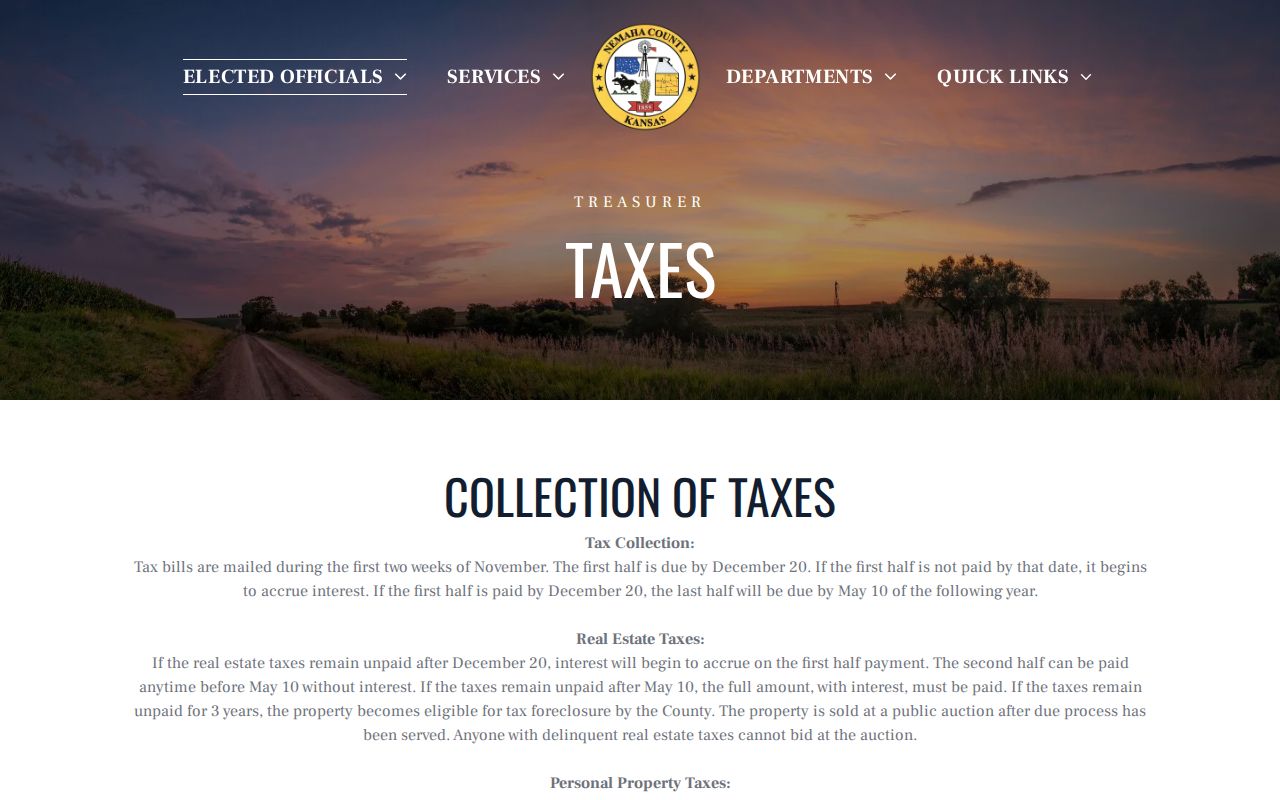
The official county tax page posts the Treasurer's collection details and payment options.
Use its Treasurer contact details to verify balances that may change with interest.
Look Up a Nemaha County Tax Bill
Select Real Estate, then enter an address, CAMA number, or owner name. Open a statement only after the legal description and parcel key match, since same-name owners and mailing addresses can mislead.
- Search the Treasurer module by address, full CAMA, or owner role.
- Match the legal description and read the statement year, payment status, and balance.
- Compare appraised and assessed figures with the Appraiser record.
- Ask the Treasurer about same-day interest, payoff, or sale status.
- Assessed value
- The appraised figure after the statutory property-class percentage.
- Mill levy
- The combined rate applied to assessed value.
- Tax relief
- A statutory credit, refund, or adjustment requiring eligibility.
- Tax lien
- The government's claim securing unpaid property tax.
Calendar Both Nemaha Payment Dates
Statements go out in the first two weeks of November, usually November 6-14. The first half is due December 20. Pay that half and the second half moves to May 10 of the following year. No second-half notice arrives, so calendar the date yourself. A late first half accrues interest. After May 10, an unpaid second half puts the full real-estate balance plus interest on the hook. The tax search's due-only control flags outstanding statements. But a precise payoff should come from the Treasurer at 785-336-2170 option 2. Real property may become eligible for foreclosure after three years delinquent. Eligibility is not a completed sale.
Improvement Rebates Require Preapproval
Nemaha County's Neighborhood Revitalization application must win approval before construction starts. It carries a $35 fee. The form wants owner and property details, the legal description, and building classification and use. It also asks for a project description with dates, cost estimates, a measured sketch, and a construction-cost questionnaire. The county plan pays a 65% rebate for five years with no minimum value increase. Sabetha and Seneca run separate city plans with their own thresholds. Approval goes void if construction has not begun within a year. Completion documentation is due by February 1 after completion. Remember, this rebates added value rather than granting a blanket exemption.
Put the 2026 Market Study in Context
The Appraiser's 2026 market study under K.S.A. 79-1460a reports a residential upward trend of 3% to 10%, depending on location and home type. Commercial property held stable with a slight upward trend. Vacant lots stayed stable too, with rural movement upward. These are countywide mass-appraisal observations, not parcel-specific sale forecasts. Nemaha's 2024 state summary showed $234,900,723 in taxable value and a 0.108844 average mill levy. Class mix and local taxing districts are why a county average can never reproduce one bill.
Separate Delinquency from a Tax Sale
The due-only checkbox is an efficient way to spot current or delinquent statements. It cannot show that a parcel has entered foreclosure or been sold. Nemaha County says real estate may become eligible for foreclosure after three years delinquent. Eligibility, a filed case, a scheduled sale, and a completed deed are distinct stages. Ask the Treasurer for the tax years, unpaid halves, accrued interest, and current status. If litigation has begun, try the Kansas court search or the courthouse public terminal. Remote document access varies under Kansas eCourt Rule 22. Confirm any completed transfer with the Register of Deeds.
Send Each Nemaha Tax Question to Its Keeper
Route each question to its keeper. The Appraiser handles parcel characteristics, classifications, valuation notices, market studies, and equalization appeals. The Treasurer collects real-estate taxes and answers statement, payment, delinquency, and payoff questions. The County Clerk prepares the real-estate and personal-property tax rolls. The Clerk also maintains tax accounts and tax-unit maps. Special-assessment rolls sit with that office too. All three offices sit at 607 Nemaha Street in Seneca. Call the Appraiser at county option 3. The Treasurer answers at option 2, and the Clerk is at option 1. A written KORA request can reach closed tax cards. It also covers special-assessment files and archived records not online. Describe the parcel and desired year precisely. Request a fee estimate before broad research begins.
Match the Kansas Assessment Class Before Calculating
Classification comes first in any Nemaha County property tax estimate. Kansas Article 11 treats residential real property differently from nearly every other class. Residential land and homes are assessed at 11.5% of appraised value. Vacant lots sit at 12%. Commercial, industrial, and agricultural-use improvements all carry a 25% assessment rate. Agricultural land is different because its value rests on productivity. That figure is assessed at 30%. Public utility property uses 33%. Qualified nonprofit property is 12%. Other rural or urban real property is 30%.
Multiply the appraised figure by the correct class percentage to reach assessed value. Then layer on the combined mill levy. Adjust for special assessments, credits, or exemptions that apply to the parcel. Skipping straight from appraised value to the countywide average levy is a common error. It misleads most on mixed-use or agricultural ground, where one parcel can hold components taxed at several rates.
Nemaha County's 2024 totals show how the base splits. Residential property made up 34.39% of taxable value. Agricultural land held 28.36%, public utility 19.34%, and commercial real property 9.55%. Those are countywide shares of the tax base, though. They say nothing about how any single property is classified.
Document a Nemaha Tax Payment Carefully
The Treasurer accepts cash, checks, money orders, and credit cards for property tax payments. A separate statewide route through Kansas.gov needs only the county tax statement. It needs only a payment method as well. That portal does not publish a Nemaha County convenience fee. Confirm the final amount on screen before submitting. Do not assume a fee copied from another county.
Good records make disputes easier. Keep the statement, the confirmation, and the payment date. Also keep the tax year, the parcel number, and which half was paid. Escrow arrangements add a wrinkle. The office says the escrow company supplies the escrow address. A homeowner who receives the statement should forward it or confirm payment happened. Past-due notices and tax-information sheets go to the homeowner, not the mortgage company. If one arrives, call the mortgage company first and the Treasurer second.
Personal property follows harsher rules. Miss the December 20 first-half deadline. The full amount plus interest can come due at once. Unpaid personal property may even be referred to the Sheriff. Keep those accounts distinct from real-estate property records.
Appeal a Nemaha County Assessment
Real-property valuation notices go out from the Appraiser by March 1. An equalization appeal must reach the Appraiser within 30 days of that mailing, and K.S.A. 79-1448 sets May 20 as the determination date. Before filing, weigh the classification, the physical characteristics, the land and improvement entries, and any comparable sales evidence that supports a different value.
Appeal window. File within 30 days of the valuation notice's mailing; contact the Nemaha County Appraiser immediately rather than waiting for a tax bill.
Personal-property rendition is due March 15 under K.S.A. 79-306, and oil-and-gas rendition falls on April 1 under K.S.A. 79-332a. A personal-property equalization appeal must land by May 15. Those deadlines run on their own calendar, separate from the real-property notice process.
Keep the notice envelope, the parcel card, and anything submitted as evidence. The mailing date on that envelope opens the real-property appeal window. The tax statement that arrives later simply reflects work the Appraiser, Clerk, and Treasurer have already finished.
Ask the Appraiser which existing property records back up the valuation. Name the assessment year in every request. Payment questions go to the Treasurer instead.