
Reconstruct Nemaha County Former Owners
Start with the most recent deed. Its grantor held the interest before the grantee. Search that grantor's name as a grantee in the next older deed, and log every line, because a shared surname alone never ties two records to the same land.
| Transfer point | Grantor to grantee | Deed type | Book/page |
|---|---|---|---|
| Newest | Seller to present grantee | Warranty or other deed | Current instrument |
| Next older | Earlier seller to that seller | Prior conveyance | Reverse-index result |
| Chain break | Estate, sheriff or heirs | Special transfer | Probate or court clue |
| Book era | Earlier named parties | Historic deed | Office book/page |
Nemaha County publishes no stated cutoff for digital deed access. Ask the Register of Deeds where the online records end and which book or microfilm continues the chain.
Go Back Through Nemaha Deed Books
The Nemaha County Register of Deeds assigns each document a recording time and book/page, then indexes it by name and legal description. The office offers no public deed-search URL. Requests go through the counter, mail, phone at 785-336-2170 option 4, fax 785-336-3373, or rod@nmcoks.us. Give a precise party name, land description, and date span. County hours run 8:00 a.m. to 4:30 p.m., open through noon. Call ahead about terminal access, copy rules, and fees.
Walk Nemaha's Deed Chain Backward
The backward method makes each former owner the next search key. Match the legal description at every step and note the deed type on each line.
- Find the present grantee's acquisition deed and copy its legal description.
- Read the grantor, then search that party as an earlier grantee.
- Repeat while matching the land, noting splits and replats.
- At the digital limit, continue through reverse indexes and deed books.
- Grantor / grantee
- The transferring and receiving parties.
- Chain of title
- The linked sequence of transfers for the same land.
- Legal description
- The land identifier that survives address changes.
Follow Nemaha Land Descriptions
Street names and numbers change over time. A legal description instead follows lot and block, subdivision, or section-township-range. If it shrinks, the tract may have split. Merging descriptions point to a combination. The Historical Society maps include an 1887 plat, a 1908 plat book, and a 1922 atlas that give context for previous owners, though a map label is not a conveyance.
Bridge Nemaha Estate Transfers
A sale-to-sale line can stop at death. Estate records bridge the gap. Search "Estate of," executor, administrator, trustee, and heir forms in the deed books. Probate starts in 1857 in the local finding aid. A docket can explain the authority behind an executor or heir deed. Mortgages, releases, assignments, and liens are not owner transfers. Never list a lender as a former owner without a deed.
Repair Nemaha Ownership Chain Breaks
A changed legal description calls for inspection. Look for a plat, replat, vacation, split, or combination. Follow the parent tract backward before the change, then identify the instrument that created the new lot. Old tax maps can offer a clue, but the recorded document is the real link. Name changes need the same care. Search initials, full names, spouse names, abbreviations, and estate forms. A sheriff deed or tax deed deserves a look at the linked court or tax-sale file. Classify each document before placing it in the chain, since an assignment or release may concern a mortgage rather than ownership. Sabetha spans two counties. Confirm the county at each geographic break. A chain that seems to vanish at the Nemaha office may continue in Brown County for a parcel on that side of the line.
Reach Nemaha's 1855 Land Trail
Nemaha County organized in 1855. The Historical Society identifies land records from that same year. Its resources also list probate from 1857. Civil court holdings begin in 1859. The collection includes census sets and the WPA Pioneer Index. The genealogy collection offers deep offline leads for names and dates.
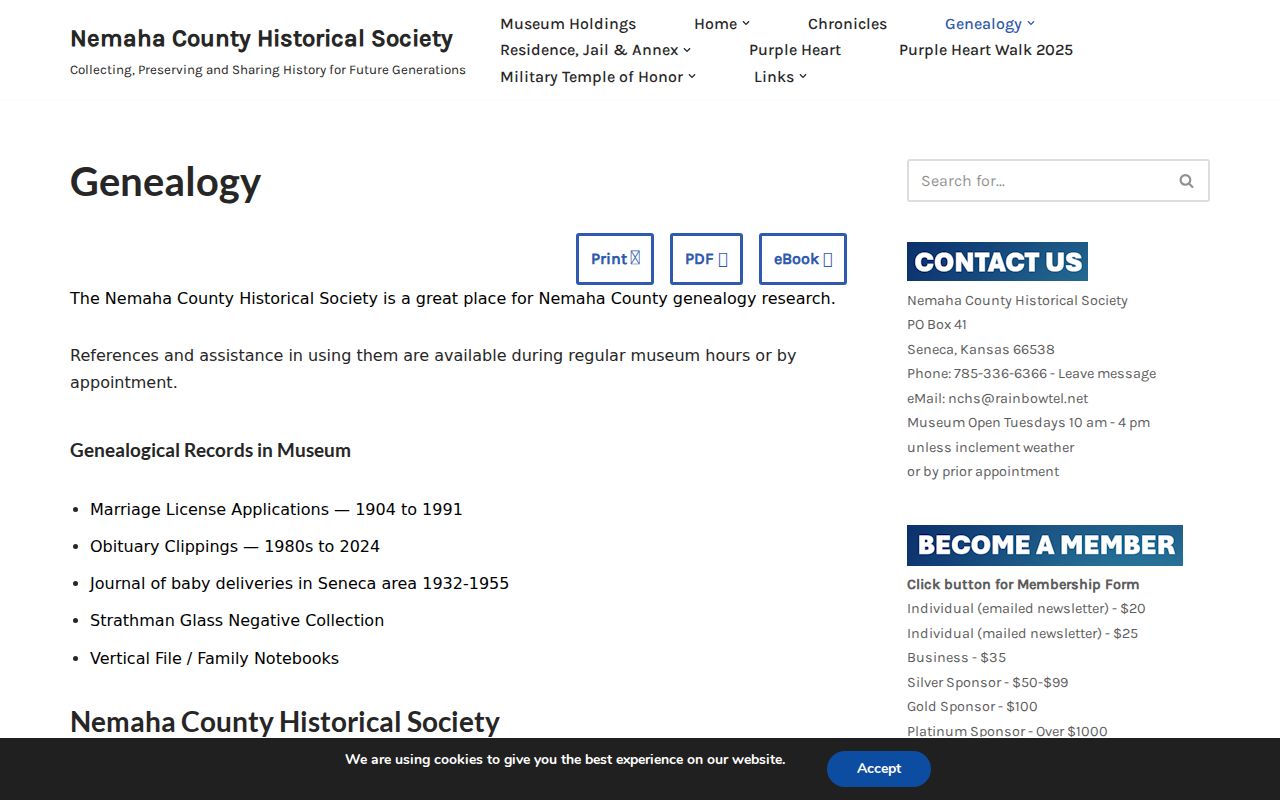
These sources help place past owners in time. Deeds still supply the transfer links.
Connect Nemaha Owners to Place
The 1879 jail and sheriff residence in Seneca became Historical Society property in 1978 and entered the National Register in 2006. Those dates layer civic use over ownership history. Each transfer still needs a deed. Sanborn sets for Seneca, Sabetha, Bern, Centralia, and Wetmore help match old footprints and uses. Bring every name back to the legal description.
Use Nemaha's Archive Route
Marriage applications run from 1904 through 1991. Obituary clippings span the 1980s through 2024, alongside family notebooks, newspapers, and photo collections. These can distinguish two people with the same name or explain an estate link. They are supporting evidence, not ownership transfers. County newspapers add more. The Sabetha Herald archive, 1888 through 2011, sits at Mary Cotton Public Library, and Seneca-area papers are at Seneca Free Public Library. Search a former owner's name near the deed date. Test any clue against the recorded land description. Museums open Tuesdays, 10:00 a.m. to 4:00 p.m., with other days by appointment. The Society asks for catalog requests two weeks ahead. That lead time matters when the online deed cutoff is unknown and the bridge may be a local book or map.
Sort Nemaha Chain Documents
The Register of Deeds files far more than deeds. Its shelves also hold mortgages, liens, oil and gas leases, city-addition plats and powers of attorney. Corporation records, cemetery records and old county-school records round out the shelves. Not every item belongs in a former-owner chain. Only a real transfer of ownership earns a spot in the timeline.
Some documents need careful sorting. A warranty deed and a quitclaim deed both convey an interest. Their promises differ sharply. A mortgage gives a lender a stake. It never makes the lender the owner of record. A release simply ends a recorded claim. An assignment moves a mortgage or lease interest. That is not the same as transferring the land itself.
For each instrument, record the type, recording date, grantor, grantee, book and page. Then add the legal description. Also link matching releases, assignments and later conveyances as separate entries. That discipline keeps a long Nemaha County chain readable and accurate.
Request Older Nemaha Owner Records
Portals run out eventually. When a catalog stops before your era, send a focused Kansas Open Records Act request. Ask for a specific index entry, deed book page, old tax roll or plat. Name the party, parcel number, legal description, document type and date range you need. The office may estimate search and copying costs and ask for prepayment.
K.S.A. 45-218 gives the agency three business days to act. The response may explain a delay and give an expected time. KORA does not obligate staff to assemble a chain-of-title report. Request the pieces instead. Then build the timeline yourself from the records returned.
Know Nemaha Former Owner Limits
Nemaha County land records begin in 1855. The online start is unknown. Older owners may call for book indexes, FamilySearch or Historical Society help. A missing web result is not a missing deed.
Lawful use. Trace prior owners for house history, title work or estate research. Never use names to stalk, harass or target a living person.
Keep a research log with one row per transfer. Record the grantor, the grantee, and the deed type just as written. Add the recording date, book and page, and the full legal description for each parcel. Flag any spelling shift, estate role, split, or plat change rather than quietly merging it. That log does two jobs at once. It exposes gaps in the chain of ownership. It also gives the Register of Deeds a precise starting point when a prior owner cannot be found in a name index.
Remember that an index is not a title opinion. Follow the Nemaha County deed records process for certified copies. Bring in a qualified professional whenever title is disputed.